
Landscape Reports & Strategic Issue Analysis
Landscape Reports & Strategic Issue Analysis
A landscape report systematically organizes the external environment within a specific disease area, therapeutic area, or product area. It provides a comprehensive, panoramic view of trends in science, healthcare, the competitive landscape, and healthcare policy.
For Medical Affairs, landscape reports serve as essential foundational information for building scientific strategies and clarifying evidence gaps and unmet medical needs.
Value of Landscape Reports

Accurate understanding of the disease area and treatment landscape
By organizing clinical trial guidelines, care pathways, patient population trends, and challenges in clinical practice, this approach clarifies the medical issues that Medical Affairs should prioritize.
Visualization of competitive and development trends
Gain a panoramic view of competitors’ development status, product characteristics, evidence strategies, and conference activities to organize your own product’s positioning and differentiation points.
Identification of evidence gaps
Guides the direction for future clinical studies, real-world evidence, and patient-reported outcome research.
Improved quality of dialogue with KOLs
By understanding disease challenges and treatment changes, MSL activities can be conducted with deeper scientific discussions.
Starting point for Medical Plan design
Correctly understanding the external environment is the starting point for developing a Medical Plan.
Example Report Structure
1. Disease and Clinical Background
2. Treatment Landscape
3. Standard of Care
4. Clinical Evidence Landscape
5. Safety and Quality of Evidence
6. Competitive Product Landscape
7. Guidelines and Consensus
8. Unmet Medical Needs
9. Future Strategy

What Is an Evidence Map?
An evidence map is a tabular database that systematically organizes key information from the literature (themes, subjects, outcomes, study designs, scale, results, etc.). It enables you to see at a glance what types of studies exist, which outcomes are frequently used, and which patient populations are being studied—serving as a comprehensive overview tool.
Evidence maps are easy to update and can be continuously accumulated as a “knowledge asset for the team.” Long-term updates allow tracking of new research trends, changes in the depth of evidence, and the impact of regulatory changes.
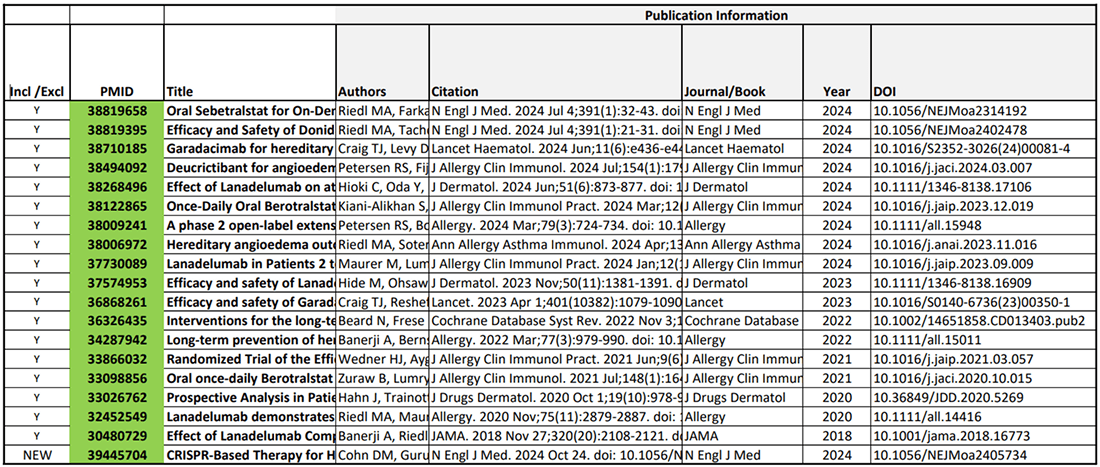
Evidence Map in Excel format

What Is a Connectome?
A connectome is an analytical method that visualizes citation relationships between publications as a network, allowing you to see at a glance which papers are central to the knowledge base and which clusters of papers form the core of a research field.
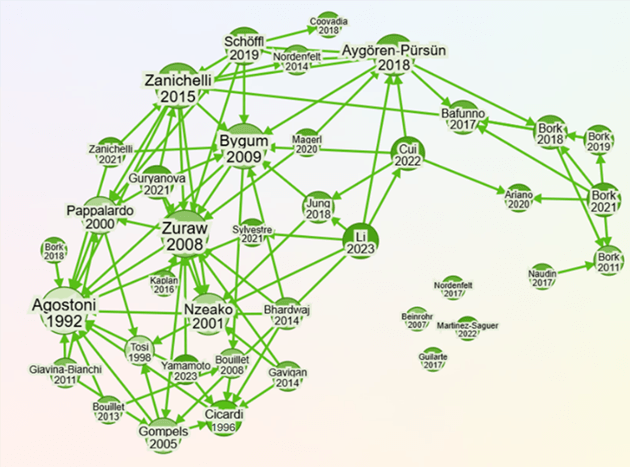
Visualization of Literature Using Connectomes
How to Use a Connectome


Focused Analysis Reports
In fields where the treatment environment and guidelines change frequently, we address the need to update data in an agile manner (small scale, short turnaround). These reports focus on specific topics (e.g., treatment pathways and sequencing) and systematically organize and analyze relevant evidence using the same methodology as landscape reports.
As a project, these are characterized by being smaller in scope and faster in delivery than full landscape reports.
Track Record
To date, we have produced more than 20 landscape reports and evidence maps for Japanese and global companies across the following disease areas:
Oncology
Diabetes
Women’s Health
Cardiovascular
Dermatology
Central Nervous
System
Hereditary Diseases